LoRA Trained for 56 Minutes, No Style: The AI Never Looked
LoRA trained for 56 minutes with no style showing? The AI never actually looked at the drawings, so it guessed the style. I'm Labo, the lighthouse keeper. My first LoRA training ran for 56 minutes and the style still didn't come out, and today I show the student exactly why. If you want to draw your own manga with AI at home, this is the mistake worth skipping: an AI that never looked at the drawings guessed the style from a genre name.

Pretty, but not the style. The question is why.
The student had been chewing on it since last time. Her dad draws webtoons and never gets a day off. She's learning all this so that one day she can teach an AI his style and take some of the repetitive work off his desk. Before she gets there, she wanted to know exactly where my first run went wrong.
"Training finished with no errors. So why isn't the style there?"
Student: You said there were no errors. And the Loss went down to 0.144, right? Lower is better, isn't it?
Labo: Loss tells you how well it learned to copy the pictures you gave it. It doesn't tell you whether it learned the style. An AI can learn the wrong thing very diligently, and the Loss still goes down. So Loss only says "the training ran." Whether it worked, you only find out by generating pictures and looking.
Student: Then what was wrong?
"The AI decided the style without seeing one drawing?"
Labo: Before training, I asked an AI to help me choose the settings. I told it only the genre: "graphic novel." It didn't look at a single drawing. It just decided, "Graphic novel, so Western ink pen lines," and set things up like this:
- Base model: AnyLoRA, a light anime-leaning model from the SD1.5 generation.
- At the front of every caption:
graphic novel illustration, dramatic shading
Student: But the style you were teaching wasn't pen lines.
Labo: Not at all. It was digital painting, brushstrokes layered on tens of thousands of times. The same scene in those two styles looks like two different worlds.
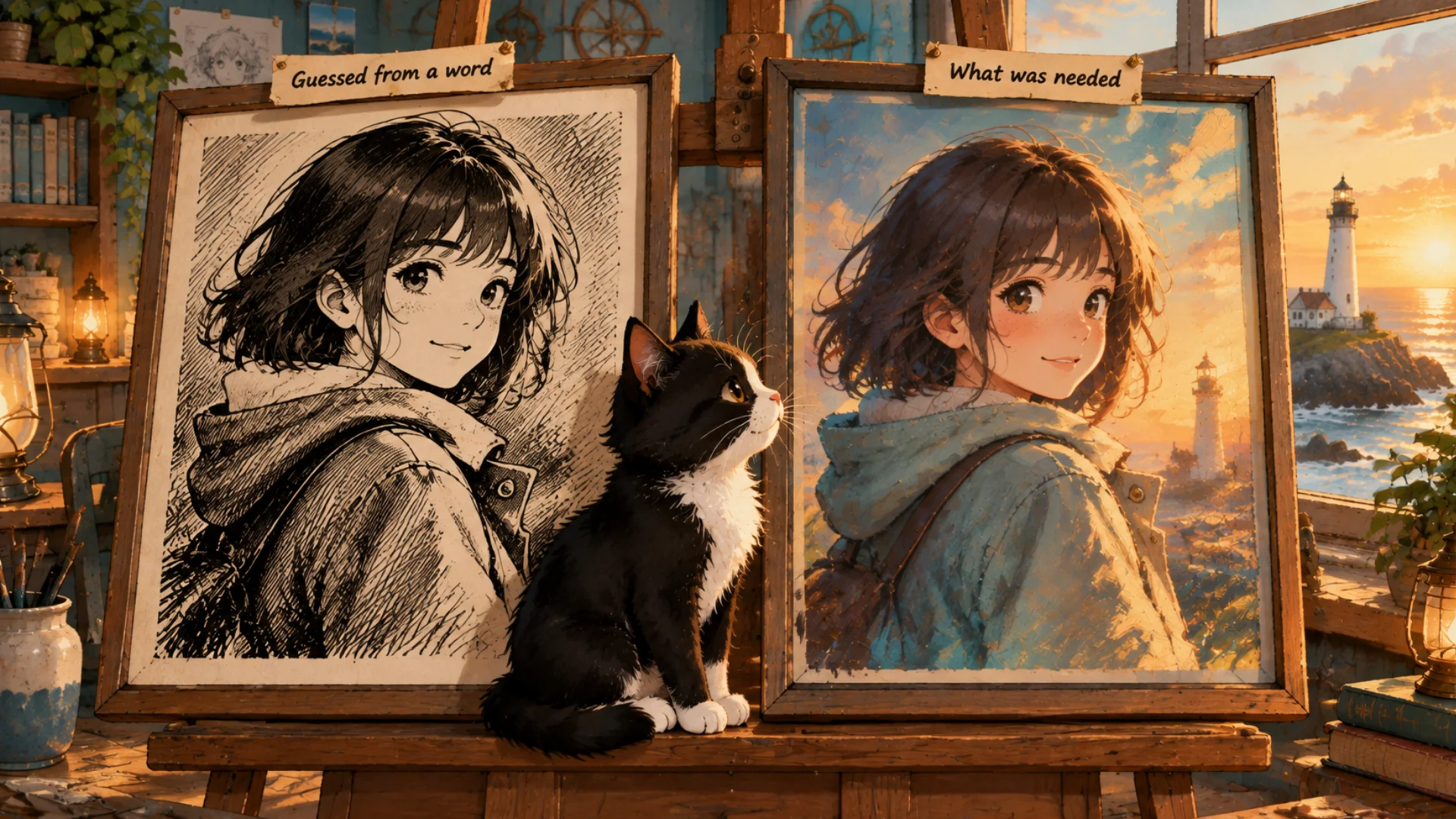
Left: what a genre name made the AI imagine. Right: what was actually needed.
Labo: And remember the caption rule from when we picked the drawings? Whatever you write in a caption, the AI learns as a separate thing. So by putting the wrong style words at the front of every caption, I blurred the very place where the real style should have stayed.
Student: So those 56 minutes...
Labo: Ran perfectly, on a wrong premise. The machine didn't make a mistake. The first sentence I handed it did.
Student: When I teach my dad's style someday, I'd probably just type "webtoon" and hit enter.
Labo: That's exactly the trap. Show the AI the work first, then ask.
"So how did you fix it?"
Labo: I rewrote the instructions I give the AI from scratch. These five lines became the rule for everything I did after that:
1. Before any new decision, look at the four works again and analyze them with your own eyes.
2. No default recommendations.
3. Don't add anything to the front of the captions automatically until I approve it.
4. Every time, tell me honestly about time, cost, risk and expected results.
5. Training that finishes in 56 minutes isn't style training. Always show me the options that take longer, too.
Student: And once you showed it four works, did things change?
Labo: Completely. The base model became AlbedoBase XL, from the SDXL generation, and the captions were rewritten from the beginning. And I learned one more thing. The style I was teaching wasn't one style. It was four: painting, card-game illustration, soft webtoon, and game concept art. "One artist, one style" was wrong from the start.
"One artist can have four styles?"
Student: Then what do you do with four?
Labo: I split the drawings into four folders and decided to teach only one branch at a time. That's where the first picking rule, "one style only," really comes from. Mix them, and the AI averages them until none of them comes out. It matters even more later, when you want a consistent character across panels: if the style underneath keeps shifting, the character drifts with it.
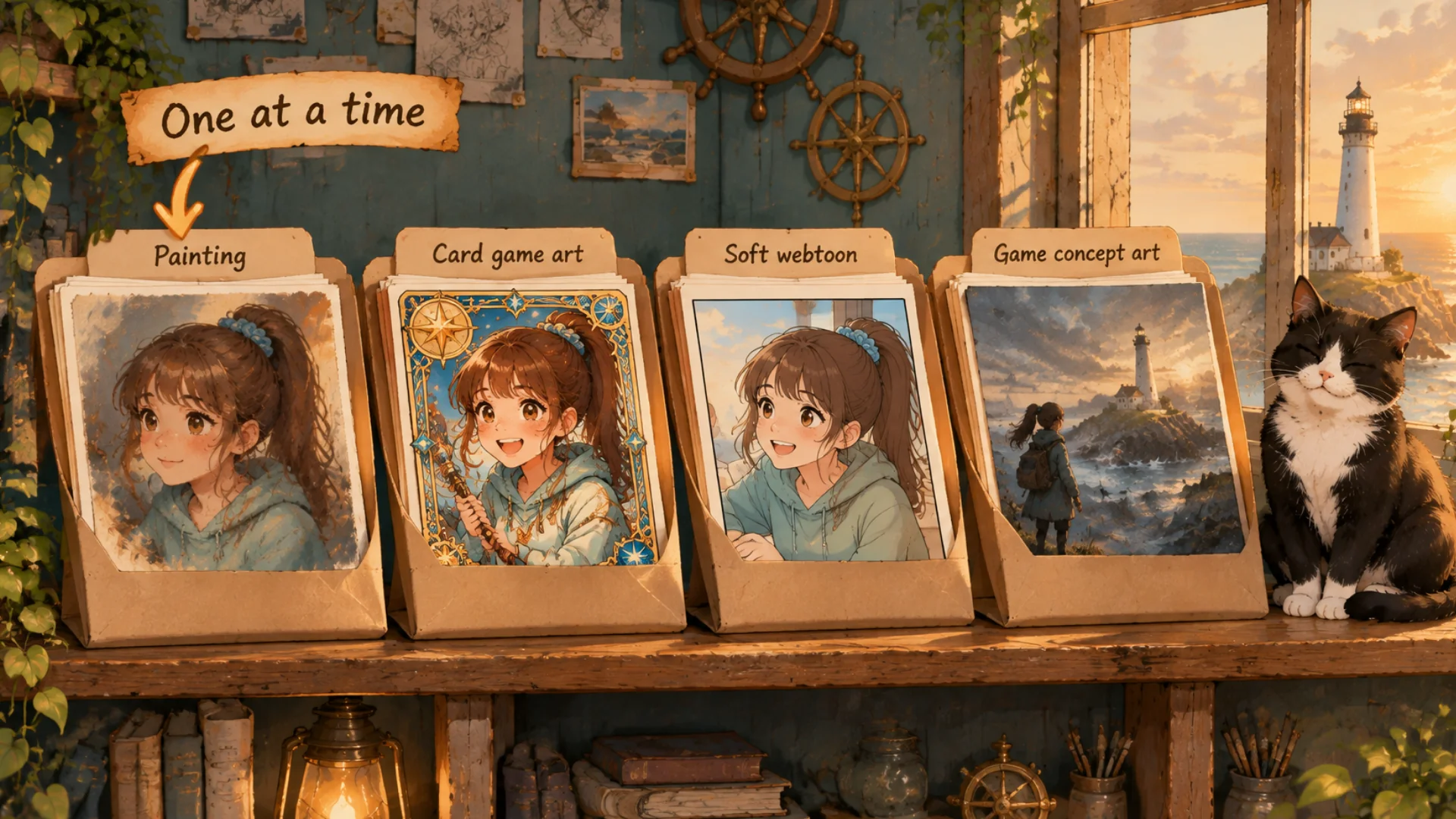
Four folders. Only one goes into training at a time.
Student: So now you just run it again with SDXL, and it works?
Labo: That's what I thought that night, too. Next time: one step took 52 seconds.
FAQ
Q. My LoRA training Loss is low, so why doesn't the style come out?
Loss means the training ran, not that it learned the style. Check first whether the base model and the captions fit that style.
Q. Can I ask an AI to choose my training settings?
Yes, but only after you've shown it the actual work. Give it just a genre name and it assumes the average of that genre.
Q. Can I put all of one artist's drawings into one LoRA?
If the style has several branches, split them. Mixed together, the AI averages them and none of them shows up.
What the artist did: looked at nine pictures and admitted they weren't the style, showed the AI four real works, wrote five rules for it, and split the drawings into four folders.
What the AI did: guessed a style from one word and trained on that guess for 56 minutes, very precisely.
Official pages: SDXL base model on Hugging Face (Stability AI) and Civitai (where SDXL-based models like AlbedoBase XL are shared).
Written October 2026. The numbers (56 minutes, Loss 0.144, four works) and the five rules are from my own record. In a Korean webtoon studio the drawings are the work itself, so none are shown here; every illustration in this post was made new. The original Korean post: 그림체 잘 나오나요? (Korean)
Lighthouse log. The machine wasn't wrong. The first sentence I handed it was. So I rewrote that sentence as five lines.
Keep reading
- Previous post: First Kohya LoRA Done, Style Missing? Checking It in SwarmUI
- More on LoRA · Kohya · SDXL
- All posts in Draw Manga with AI at Home


Comments
Post a Comment