How Many Drawings to Train a LoRA? Picks, Captions, Trigger
How many drawings do you need to train a LoRA? Fewer than you think, as long as each one passes your rules. I'm Labo, the lighthouse keeper. When you want to draw your own manga with AI at home, the first real job isn't the program. It's deciding how many drawings to train a LoRA on, and which ones. What I learned the hard way: the drawings you need aren't the most, they're the ones that pass the rules.
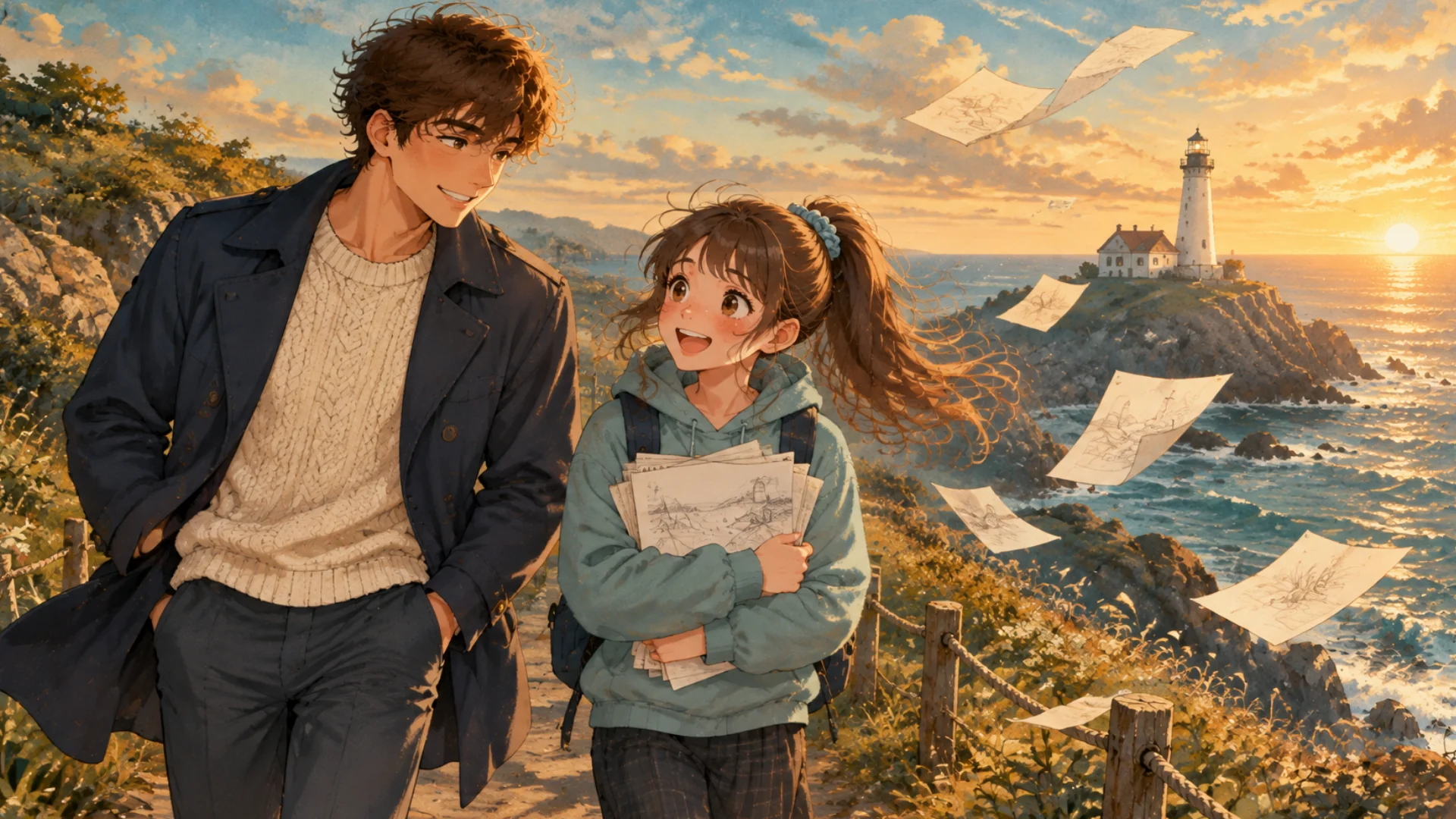
A USB stick full of drawings, and the question of which ones go in.
A day after Kohya finally opened on her computer, the student came back with a USB stick. Her dad's drawings, a lot of them. He draws webtoons, and she wants to teach an AI his style so he gets a little time back.
Student: Labo, do I just put all of these in?
Labo: No. Today is about picking. But one promise first: an artist's drawings are private. In a Korean webtoon studio they're the work itself. So we'll practice on a set I made separately. The rules are the same.
"Doesn't it learn better if I put everything in?"
Labo: For one style, a few dozen is enough. The first time I taught a style, I picked 30 drawings and ended up putting in 75. When I finally made one that worked, it was 55. The count matters less than four rules.
- One style only. If different styles are mixed, the AI averages them.
- No text. Speech bubbles, sound effects, signatures. The AI learns those as part of the style.
- Big enough. Over 1,000 pixels on the long side. Over 3,000, shrink it before it goes in.
- One of each. If several drawings share almost the same pose, the AI memorizes that pose.
"Let's pick together. How many out of 24?"
Labo: Here are 24 drawings in one style. I hid some traps in there on purpose. Which would you take out?
Student: Hmm. The ones with speech bubbles, the one that looks like a different comic, the tiny one?
Labo: Almost all of it. There were six traps: two with speech bubbles or text, one in a different style (flat anime coloring), one too small, one that was nearly the same pose as another, so we keep the better of the two, and one with tangled fingers. Put in something drawn wrong, and it learns the wrong thing. Two more just looked off, so they went too. Sixteen stay.
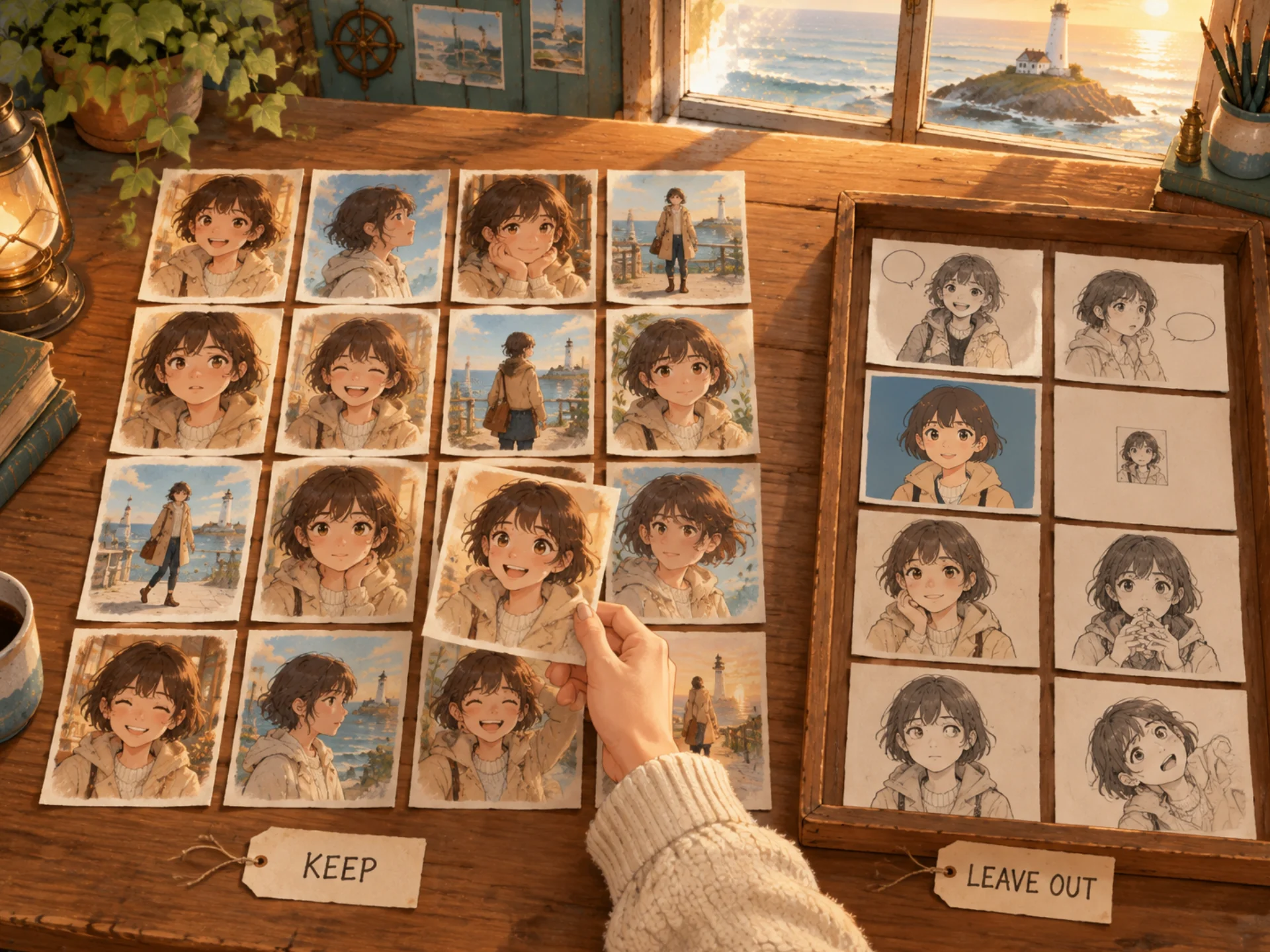
The tray on the right teaches the AI nothing, and that's the point.
Student: Does the mix of the ones we keep matter too?
Labo: Yes. If you only put in face close-ups, it can't draw a full body. When you pick your dad's drawings, look at the balance: close-ups, upper body, full body, scenes with a background, roughly even. That balance is what you'll lean on later for a consistent character across panels, a close-up in one panel and the whole figure in the next, still in the same hand.
"What's a caption?"
Labo: A short description for each drawing. Next to 01.png you put 01.txt and write what's in the picture. One rule: don't describe the style. Only what's in the picture.
Student: We're teaching the style, and we don't write the style?
Labo: Whatever you write, the AI treats as "this changes from picture to picture" and learns separately. What you don't write, the thing every drawing shares, is what stays behind as the style. Write the style down and it scatters. Here's what three of the kept drawings look like:
F1.txt   lbtoon01, a young woman with short dark hair, face close-up, front view, window light, evening
U1.txt   lbtoon01, a young woman in a beige coat, upper body, holding a coffee cup, cafe
B4.txt   lbtoon01, a young woman in a beige coat, full body, from behind, foggy pier
Student: In English?
Labo: In English. And the wording shifts with the base model. A model like AlbedoBase understands short sentences like these. Anime-leaning models, Illustrious for example, understand tags better, like 1girl, short hair, upper body. When I switched models later, I switched how I wrote captions too.
"What's the word at the very front?"
Labo: The trigger word. A name for the style. Put the same word at the front of every caption, and later that one word in a prompt calls the style back. lbtoon01 is one I made up for this post. The rule: a word that doesn't exist. A common word gets mixed up with what the AI already thinks it means.
Student: Can't I just use my dad's pen name?
Labo: I spent a long time on that question myself. The AI may have seen a pen name somewhere, so it's not a good choice. Twist it into a new word instead. And one more thing: never write your real trigger word anywhere public. It's the key that opens the style.
"Why does the folder name start with 5_?"
Labo: That's a Kohya rule. Name the folder something like 5_lbtoon01, and the number in front is how many times it looks at each drawing in one round. That sets how long training runs:
Drawings × that number × rounds (epochs) = total steps
Our practice set: 16 × 5 × 10 rounds = 800 steps
The one that finally worked for me: 55 × 5 × 10 rounds = 2,750 steps
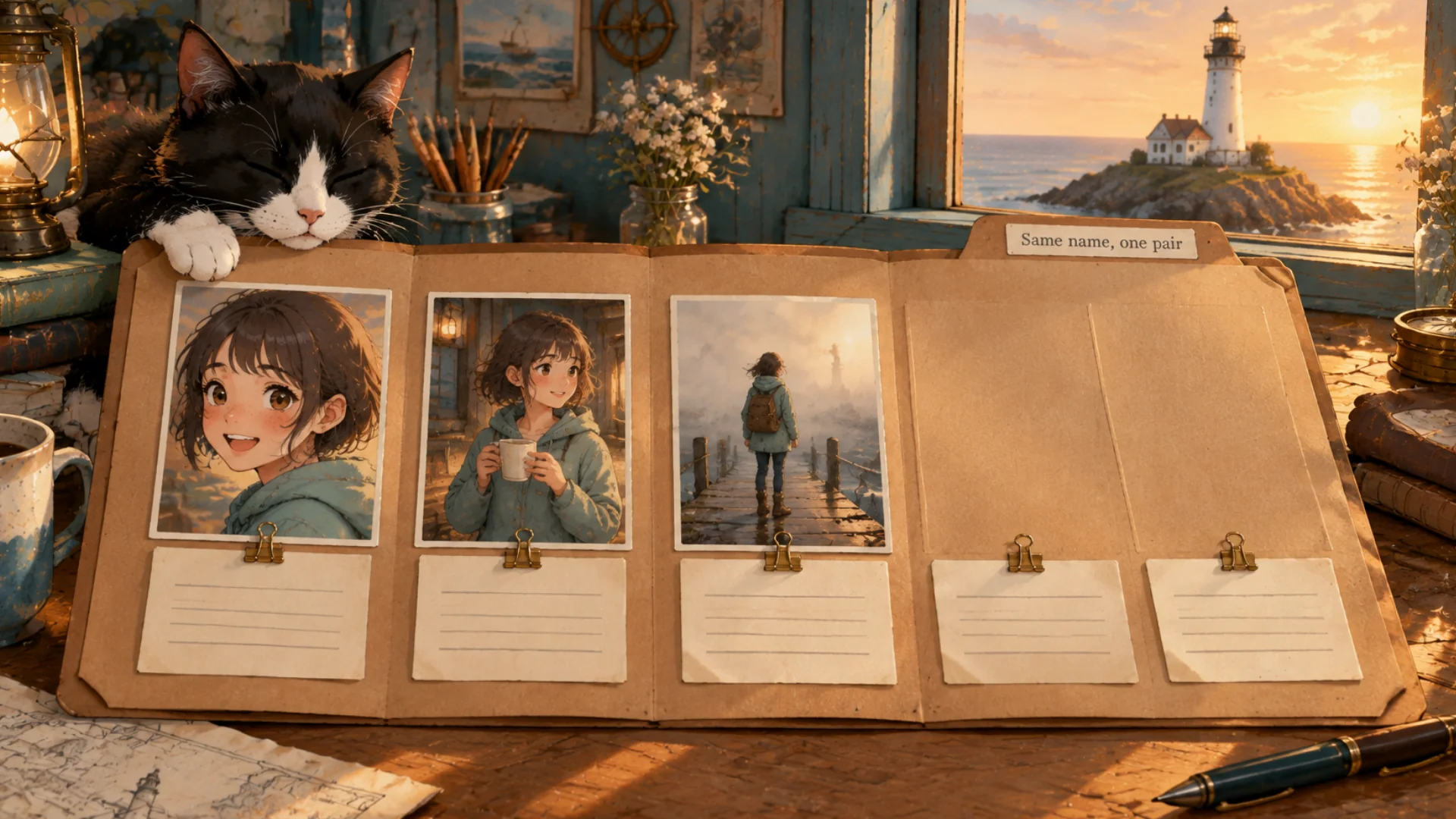
A picture and its caption share a name. That's the shape Kohya reads.
Student: So now I put it into Kohya and press Start?
Labo: Yes. But there are quite a few boxes before Start. And when it finishes, one file drops out, and where you open it is a whole other job. That's next time.
FAQ
Q. How many drawings do I need to train a LoRA on one style?
Start somewhere between 30 and 80. More than the count, check that close-ups, upper body, full body and background scenes are evenly mixed.
Q. Which drawings should I leave out?
Anything with text, a different style, too small, a repeat of the same pose, or something drawn wrong.
Q. Should the caption describe the art style?
No. Write only what's in the picture: person, framing, place, lighting. The trigger word goes first.
What the artist did: chose which drawings go in and which stay out, wrote what's in each one, and named the style with a word that doesn't exist.
What the AI did: nothing yet. It will learn whatever is left in the folder, mistakes included.
Official pages: Kohya_ss on GitHub (open source, free; the folder layout and captions are explained there) and Civitai (where SDXL models like AlbedoBase XL are shared). Keep the training folder outside OneDrive, Google Drive or iCloud sync folders, or the drawings get uploaded.
Written October 2026. The example drawings and the trigger word were made new for practice; no real artwork or real trigger word is used. The balance of shots is my own rule of thumb, not the only answer. The original Korean post: 그림은 몇 장 준비해야 할까? (Korean)
Lighthouse log. A good crew isn't the biggest one, it's the one that fits the ship. Teaching is choosing what to leave out, the way eight of twenty-four drawings went into the tray.
Keep reading
- Previous post: Why Does AI Art Need NVIDIA? CPU vs GPU and Minimum Specs
- More on LoRA · Kohya
- All posts in Draw Manga with AI at Home


Comments
Post a Comment