Can AI Write Your LoRA Captions? Three AIs on 88 Drawings
Can AI write your LoRA captions for you? Yes, but I had three AIs cross-check 88 drawings because one AI alone missed things. I'm Labo, the lighthouse keeper. Today's question is whether you can let AI write your LoRA captions, the little txt file that sits next to every training drawing. I had Claude, GPT and Grok check each other's captions for 88 drawings for a line-art LoRA. What that taught me most: a word that wasn't in the captions won't work in the prompt either.
One short line of text for every drawing, and three readers looking at it.
Last time we taught the body on its own. The student, whose dad draws webtoons and never gets a day off, wants to help him draw his manga with AI at home. Today she came with her notebook open.
"What exactly is a LoRA caption?"
Student: Labo, isn't a caption just the same thing as a prompt?
Labo: They look alike but come at different times. A prompt is for generating: "draw me this." A caption is for teaching: "this picture is this."
Student: So where do I write it?
Labo: In a txt file with the same name as the drawing, right next to it in the training folder:
C:\lora_example\5_lbtoon01\
  001.png
  001.txt
  002.png
  002.txt
Matching names are how Kohya pairs them. Get one name wrong and that drawing is learned with no description.
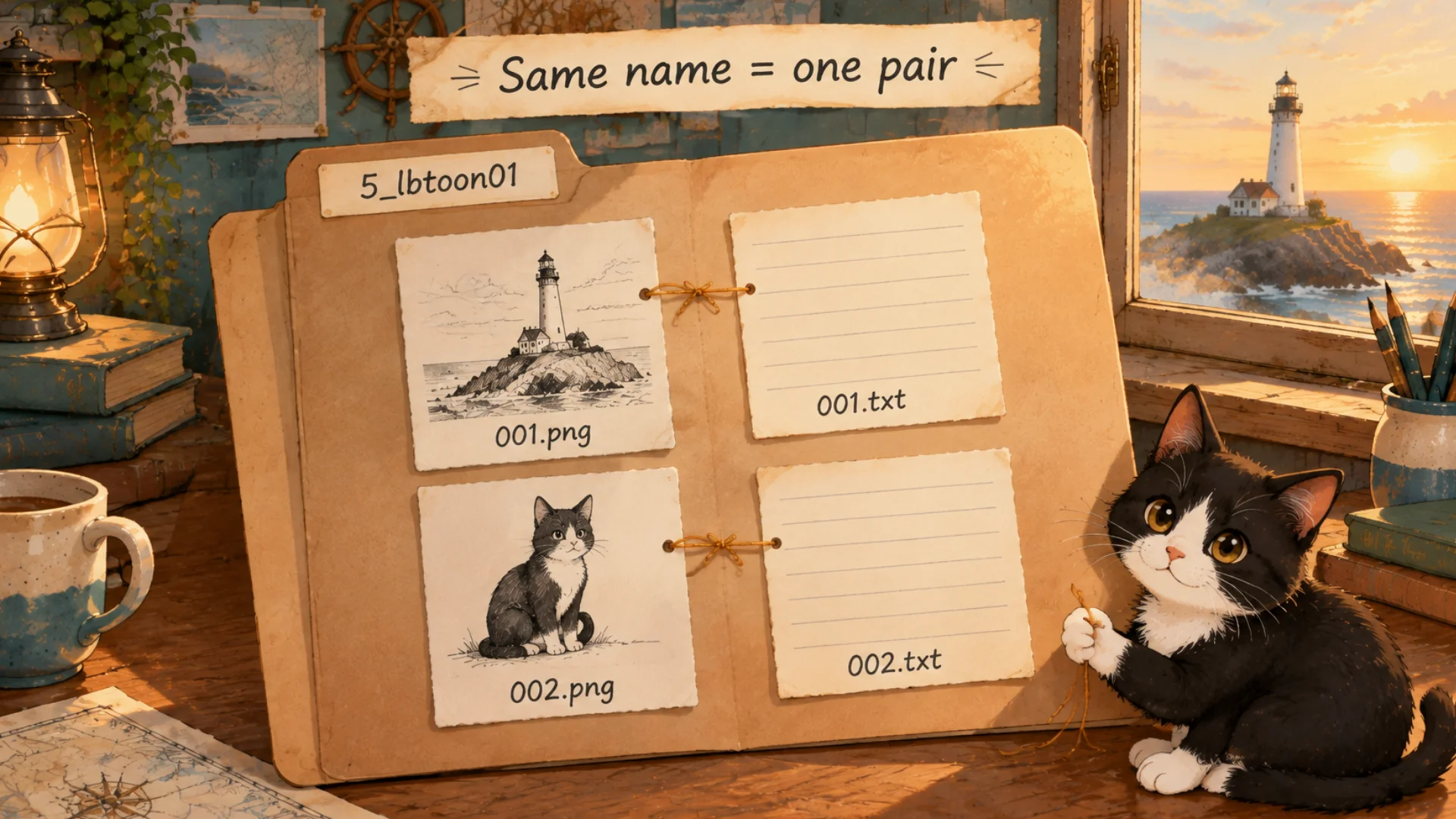
Example names only. Same name, one pair.
Student: So 88 drawings means 88 txt files?
Labo: Yes, and I handed them to AI.
"If three AIs write them, do they all agree?"
Student: Why three? Wouldn't one do?
Labo: When my first training failed, an AI had decided things without looking at a single drawing. For my 55-drawing LoRA, Claude and GPT reviewed each other. This time I added Grok.
From July 3 to 4, this is how the captions for the 88 line-art drawings were made:
- Claude, GPT and Grok cross-checked the captions for the same drawings
- Places where they disagreed: 22
- Claude corrected 3 of its own mistakes
Student: Twenty-two! What did they fight about?
Labo: I didn't write down what each one was; I kept the numbers. But with only one AI, those 3 might have gone into training wrong. So: You can let AI write captions. Just don't leave it to one. They catch each other, but the final call is a person's.
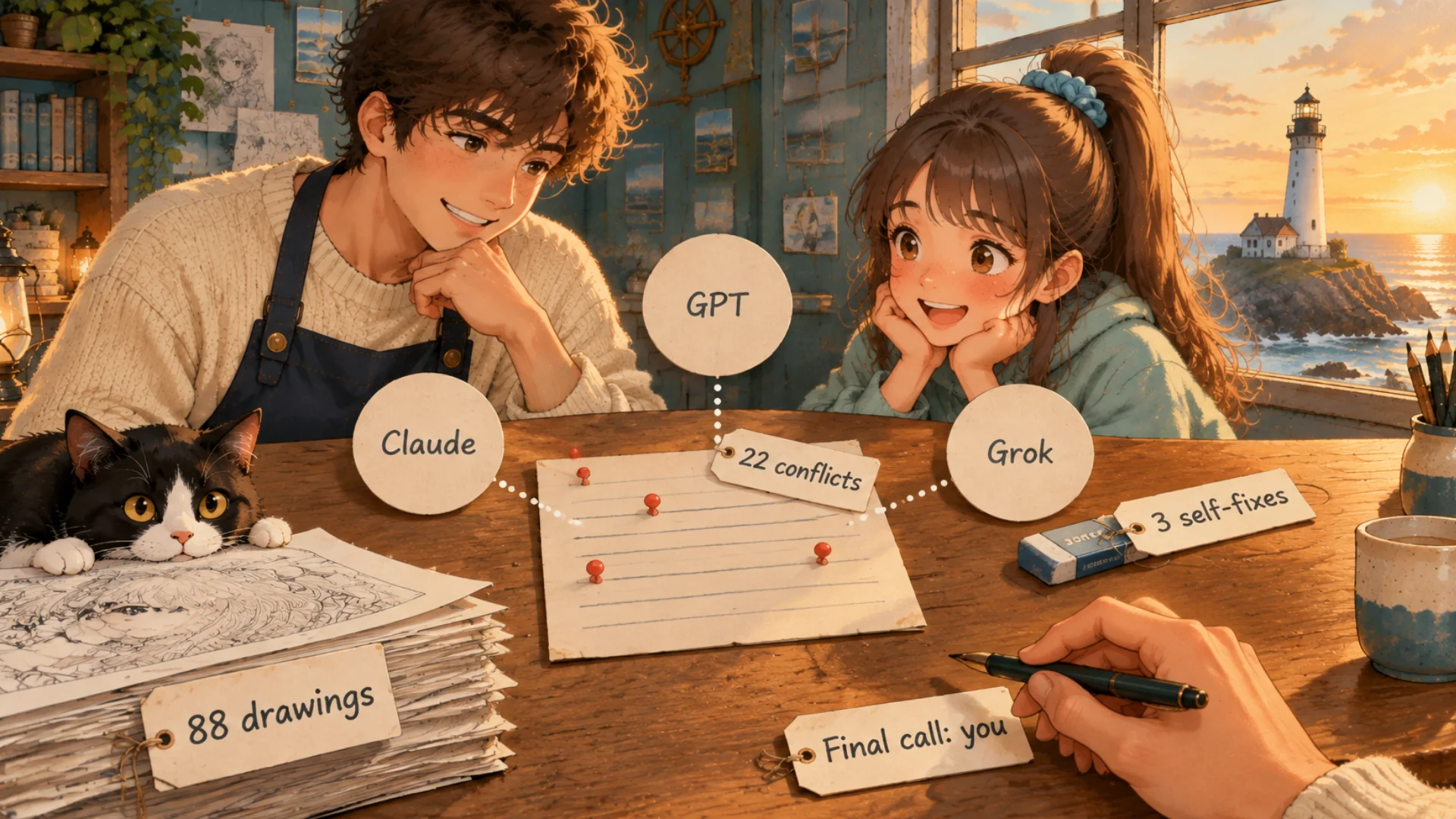
Three readers, one note, and a human pen at the end.
"What does a caption look like?"
Labo: For these 88 I did three things:
- Tag style (booru style): words split by commas, not sentences
- Shuffled order: the tag order is mixed every time it trains
- First word fixed: the front spot is the trigger word, so it never moves
I can't show real captions, so here's a fake one with the content changed:
lbtoon01, 1girl, solo, standing, long coat, short hair, looking at viewer, lineart, monochrome, white_backgroundStudent: And lbtoon01 at the front is the trigger?
Labo: An example one, yes. Shuffling stops it from learning only the front words hard; the trigger stays first because it's the LoRA's name.
Student: Wait, didn't you say Albedo uses sentences?
Labo: Right. Each base model wants a different caption style, depending on what text it first learned from:
| Base | Caption style | Fake example |
|---|---|---|
| Illustrious family | tags | lbtoon01, 1girl, solo, long coat |
| Albedo (AlbedoBase XL) | natural sentences | lbtoon01, a young woman in a long coat standing alone |
| Pony family | score tags | score_9, lbtoon01, 1girl, solo |
Student: Did you try Pony?
Labo: I did. I didn't like the results, so I dropped it.
"Why doesn't a word work in the prompt if it wasn't in the captions?"
Labo: I trained these 88 drawings twice, with the same settings:
- 88 drawings × 7 repeats = 616 looks per epoch
- 10 epochs, batch 2 (two drawings at a time)
- LoCon (a LoRA type that reaches a little wider), dim 16 / alpha 8: the size of the box it learns into, and how strongly that is applied
- Learning rate 1e-4, text encoder (the part reading captions) 5e-5
- cosine schedule
- Max resolution bucket 2048
- The second run: 3,110 steps
Student: So what was different between the two runs?
Labo: Exactly two things: the trigger word, and whether the captions had lineart, monochrome and white_background. The run with those tags came out more reliably when I called it.
Student: Couldn't the other run just get lineart in the prompt?
Labo: I thought so too. That's the biggest lesson. A word that wasn't in the training captions won't work in the prompt. A LoRA learns words paired with pictures; a word it never saw points to nothing. I used to start my prompts with a long phrase. On July 4 I compared real outputs and threw it out. It had never been in the captions.
Student: So any word I'll want to call later has to be in the captions from the start.
Labo: That's it. Captions teach the words you'll use later, and calling the same thing by the same word helps keep a consistent character across panels.
"How strong should the LoRA weight be?"
Student: Do I just set the line-art LoRA to 1?
Labo: I tested six weights. Between 0.75 and 0.8, a full-body shot came out cut down to the upper body. So my default now is weight 0.7 in txt2img, with the negative prompt color, colored, realistic, photo, 3d to keep it from drifting into color or realism.
Student: Good captions plus 0.7, and I get any picture I want?
Labo: Not quite. The prompt alone still didn't give me what I wanted, so I started putting in sketches: one with shading, one with black-and-white lines only.
Student: Does a sketch change things?
Labo: That's next time: putting your own sketch into ControlNet.
FAQ
Q. What's the difference between a LoRA caption and a prompt?
A prompt is for generating, a caption for teaching: a txt file named like the drawing.
Q. Can I let AI write my LoRA captions?
I did, with Claude, GPT and Grok checking each other: 22 conflicts on 88 drawings, 3 self-fixes by Claude. Don't leave it to one; make the final call yourself.
Q. I typed lineart in the prompt but don't get line art. Why?
A word that wasn't in the training captions won't work in the prompt. The run with lineart, monochrome and white_background in its captions came out more reliably.
What the artist did: picked the 88 drawings, chose tag style with shuffled order and a fixed trigger, compared two runs that differed in only two things, tested six weights and set 0.7, and threw out a prompt phrase the captions never had.
What the AI did: Claude, GPT and Grok cross-checked 88 captions (22 conflicts, 3 self-fixes); Kohya trained two runs of 10 epochs.
Official pages: Kohya_ss on GitHub (open source, free). GitHub is a site where code is shared in the open, so anyone can see what's inside before running it.
Written October 2026 from Labo's own records. Settings and weights are for my line-art LoRA; yours may differ. Kohya and the AI services may change. The original Korean post: 로라 캡션, AI한테 맡겨도 돼요? (Korean)
Lighthouse log. A sea you never wrote in the logbook can't be found again. Three hands writing together show the crooked line, but the captain writes the last one.
Keep reading
- Previous post: LoRA Breaking the Body? A Separate Anatomy Dataset First
- More on LoRA · AI art
- All posts in Draw Manga with AI at Home


Comments
Post a Comment